Tag: Agile Testing Days

The Agile Testing Days 2014: Conference Day 2

The first keynote of day 2 “Test First Saves The World”, was Joe Justice who talked about applying Scrum in non-software industries, including the automobile industry. He also presented a very exciting project which attempts to build a car: http://wikispeed.org/car/

In fact, he brought parts of a car and invited the conference attendees to join a Scrum team and build a car in the hotel lobby.

People building a car in the hotel lobby
Building a car at the Agile Testing Days 2014

Joe also pointed to another project he started: The MicroHouse, that aims to provide a clean bathroom, a clean bedroom, a lockable front door at less than 100 USD. It is this project that is linked to the “save the world” part of the presentation title.

In the second keynote Fanny Pittack and Alexander Schwartz presented “Insights from Happy Change Agents”. Both of them have presented at previous conferences, but this time they went for a pair presentation and a keynote — even though they have never worked together before. I found this one very inspiring, to say the least. They demonstrated how a coach can take on the perspective of a team, rather than using her (or his) point of view from the outside. In addition to that, there was also a pair exercise for the attendees to do. They also shared their slides:

To me, the talk was not only about changing your point of view, but also about trust in a team as well as a single person. When the question session started, I made an unusual (for me) move and asked whether someone from the audience was willing to prepare a pair presentation submission for next year’s Agile Testing Days. Then two things happened rather quickly: First José Díaz announced, that if I find a pairing partner, then the session is already accepted:

How awesome — and trusting! — is that? The second thing to happen: The first person I noticed to signal willingness to co-present with me was George Dinwiddie. We met in person for the first time at this conference, have never worked together before and we’re separated by the Atlantic Ocean. I expect to have great fun and learn a lot while working on our presentation. I am sure that we will figure out how a distributed team (of two) can work.

Even now as I write this — a week later — I’m amazed, impressed and honoured by the trust and friendliness of all this. Thank you all: Every single one in the audience in general and George & José in particular!

After this, I had a short break from the ‘regular talks’ and attended the Open Space session (there were six of them, throughout the conference!) facilitated by Alex Schladebeck and Meike Mertsch. Since there were not too many people attending the sessions, we changed the format to a Lean Coffee. I like it a lot when a format is changed ‘on the fly’ in order to match the circumstances, instead of sticking to a plan that doesn’t fit well anymore.

Among other things, we discussed the question “What makes a good session at this conference?”, brought in by George and me, since we wanted to know what it is that people like about a session. Thank you for voting on this topic to everyone who attended!

The third keynote of the day was David Evans’ “The Three Pillars of Testing”. He explained how testing and agile fit together and placed just the right amount of puns into his talk. He explained the classic order of capitals, what ‘Euthynteria’ is — and what is isn’t:

Do not confuse euthynteria with 'youth interior'
What ‘euthynteria’ is — and what it is not

This was the end of a very pleasant and entertaining second conference day.

The Agile Testing Days 2014: Conference Day 1

If you’ve read my previous post about the tutorial day, you may wonder why there’s another ‘Day 1’. — Well, the official conference program mentions the 11th of November as the 1st day, so I stick with that.

For me the day started with a Lean Coffee, a format where people meet, gather topics everyone can bring, vote on these topics and then discuss the topics based on that voting (see the link to the site for more information). I like this format, because it allows to get to introduce a topic and discuss it without spending much time. That way one can see whether at least some other people are interested in a particular topic.

Afterwards, Lisa Crispin & Janet Gregory gave the inspiring first keynote, titled “WELCOME TO THE FUTURE – Preparing For Your Agile Testing Journeys”. They presented their view of how software testing may be in the future and also shared the slides. I liked the Star Trek theme presentation, which also nicely matched the topic.

Next, I attended George Dinwiddie‘s talk “A Poet’s Guide To Automated Testing”. He demonstrated how important a good choice of words is, when writing automated tests. By questioning every single word in a rather typical test, he showed how the tests can be improved. For example a typical test often reads: “When I log in to the system…”.

Who is the ‘I’ mentioned in that line? A customer? A system administrator? The ‘I’ who wrote the test, whatever his or her role was? — After a while, sometimes a rather short while, this knowledge gets lost. So it’s usually better to make this knowledge explicit in the automated test.

The following presentation by Carlos Sanchez was titled “Continuous Delivery, the Next Frontier”. I found it very interesting to see him talking about Docker a lot. Also interesting was so see that, while many people know about Docker and also use it, not many people do use it in a production environment, at least none of the people attending the talk.

Also he provided a funny explanation about where Docker works:

In the the early afternoon I attended Jeff “Cheezy” Morgan‘s workshop “Patterns of Automation”. There was an enormous amount of interest in the workshop and the room filled up quickly. He gave a good number of patterns and even (successfully!) live coded his examples. Super interesting, entertaining and funny!

At the end of the conference part of the day Bob “The Flowchain Sensei” Marshall gave his keynote “The Antimatter Principle” (explained on his blog), a very inspiring, thought-provoking and slideless presentation.

The conference day ended with the now traditional Halloween and costume party, excellent food, super interesting conversations and Matt Heusser receiving the “Most Influential Agile Testing Professional Person” award. Congratulations!

The Agile Testing Days 2014 – Day 1: The Tutorial

The 1st day of the Agile Testing Days for me was a full-day tutorial by Alan ‘The Evil Tester’ Richardson about technical testing. The tutorial was very hands on, and we actually tested something — a website.

I liked how we started with the website as such and focused on the relatively simple aspects of getting a user account and logging in. We did some testing and then reflected on what we were doing and how we did it. For example there were various ways of note-taking:

  • I mostly used pen & paper, and for some notes a text editor (e.g. when I knew that I would like to make a note of text I would enter more than once)
  • Some used their text editor of choice, Evernote or similar tools.

After interacting with the application ‘just’ using the basic browser feature of rendering HTML, we stepped down to a slightly deeper technical level and used ‘developer tools’. These allow interaction with the DOM and, for example, manipulate what an HTML form would submit back to the server — including, but not limited to, selected values of drop down lists. — While not every user will do that, some will. And it’s a good idea to test that your server can candle this unexpected input. We also looked into a number of tools to capture (and again manipulate) network traffic, such as HTTP proxies.

I liked how ‘technical testing’ was presented as something that is different from ‘test automation’. Many of the tools we use for testing enhance our possibilities as testers — and sometimes they also allow for some automation. The main point of technical testing though, is increasing the testers reach into the technical details of the system under test.

This is what I expected from the day and also what was delivered in the tutorial.

Thank you Alan, I liked it a lot!

Agile Testing Days 2012 — YAS (Yet Another Summary)

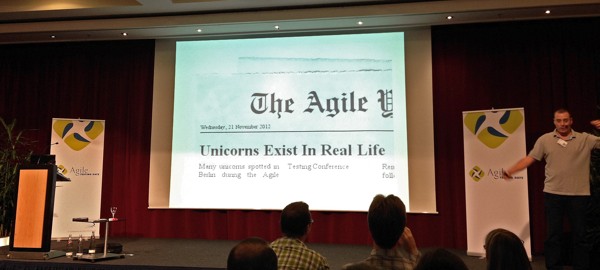
Just like the years before I enjoyed the Agile Testing Days a lot. A fun theme throughout many of the talks were… unicorns and I think Gojko Adzic started it. This affected my brain so much, I said ‘Look, a unicorn!’ to my dog, when I took him for a walk for the first time after I came back from the conference. Actually, the animal crossing our path was a squirrel.

Here’s a short summary of my favourite parts. In order to stay in sync. with the printed & online conference program I’ll start counting the conference days at 0.

Day 0 – Tutorial “Software Testing Reloaded” with Matt Heusser & Pete Walen

Just as the full title “Software Testing Reloaded – So you wanna actually DO something? We’ve got just the workshop for you. Now with even less PowerPoint!” promised, there was only very little PowerPoint and a whole lot of testing & questioning.

I especially liked the way Pete & Matt presented the examples & exercises as well as the reasoning behind them.

Electronic Dice
Electronic Dice

There were a lot of games and actual testing. All was very hands on, well explained and debriefed at the end. To give just one example: We tested electronic dice, in order to give an estimation about how long testing would take and to come up with a recommendation whether these dice were ready to be used.

Questions like “Can we ship it now?”, “Is there a pattern/problem there?” and “What actually are the requirements?” were covered.

I also won a price, so my point of view might be biased. 😉

How to Reduce the Cost of Software Testing

Day 1

  • Get them in(volved) by Arie van Bennekum
    I found it super interesting to listen to one of the creators of the Agile Manifesto, especially since he pointed out that many of the principles and values have been around before the manifesto was written.
  • Myths About Agile Testing, De-Bunked by Janet Gregory & Lisa Crispin
    Lisa & Janet debunked myths as ‘Testing is dead’, ‘Testers must be able to code’ and ‘Agile = Faster’. Excellent story and fun presentation.
  • Consensus Talks – 7 10-minute-talks (including mine)
    The format of 10-minute talks, all back-to-back and no break included was the one I missed in the previous Agile Testing Days. This way a whole lot of ground is covered in a short time and it’s a great opportunity to explore new techniques in presenting without doing too much harm and/or presenting on conferences for the first time.
  • Self Coaching by Lasse Koskela
    Lasse explained how to coach yourself. After explaining how the human brain works he talked about how to step ‘out of the box’ (your personal point of view) in order to better understand what others actually say and to stay honest to yourself at the same time. Deep knowledge, very well explained indeed.
  • The MIATPP Award Night 2012
    Lisa Crispin won the MIATPP Award. Congratulations!

Day 2

  • Test Lab by James Lyndsay & Bart Knaack
    This year I went to the “Test Lab” and tested a small LEGO Mindstorm robot, that could move around on a coloured sheet of paper and react, depending which colour its camera would detect. The task: Find out what the specification of the robot is and find defects in its implementation.
    Very interesting: We had to come up with a hypothesis of how the robot was supposed to work as well as finding defects. I really enjoyed the way Bart & James gave feedback and asked the right questions.
  • “Reinventing software quality” – Gojko Adzic
    Breaking News: Unicorns Exist

    Gojko made the point that in agile testing we might (still) not focus on the right thing: To build the right software. Instead we concentrate on finding bugs and building the software in the right way. He illustrated this with one of his books:  He found a defect and then spent a while searching & listing more problems and ended up with a good number of them, definitely enough to make you worry about the quality of the book. However, the publisher explained that essentially all reviews were very positive! So: When people keep paying for your product or service, worrying about defects may not be that important.

Day 3

  • “Fast Feedback Teams” – Ola Ellnestam
    explained the importance and value of fast feedback. And he’s right: In many projects feedback could be gathered a lot earlier and be used to improve what features are built (as well as how they’re built). Other talks at least touched this topic as well. And while I wholeheartedly agree about this, I’m also a bit worried that we (as software creators) might forget about (or even ignore) slow changing aspects (for more about this see my previous post ‘Slow Feedback Cycles‘).
  • “Exceptions, Assumptions and Ambiguity: Finding the truth behind the Story” by David Evans
    UK Explained

    David explained how natural language is ambiguous, unclear and sometimes hard to understand. His examples included part of Jabberwocky (in several natural languages), music lyrics and last but not least programming. Also, I like his short introduction of the Cotswolds.

  • “It’s the Economy, Stupid! Learn the fundamentals about the one and only argument which will drag your management into agile practices” by Lucius Bobikiewicz
    Lucius talked about economic reasons of letting teams focus on 1 (one!) project/product, as opposed to working on multiple projects/products at the same time. It didn’t surprise me much, that letting teams finish one thing and then progress with the next is economically favourable. But  I was very surprised how much of a difference it made in the example he presented. These are the main advantages of the 1-project-only team Lucius presented:

    1. The time between the 1st project start and the first paid project (usually at the end of the project) is much smaller, meaning that significantly less money is needed to fund the upfront costs.
    2. Given the limited period of time in which a software can be sold, the product can likely be launched at the optimal time, whereas multi-product-teams may enter the market later and therefore always lag in selling.
    3. Since the overhead of context switching is minimised, the team can work on more projects/products per time unit. This advantage depends on the amount of time needed per context switch and the time the projects take .

    The economic point of view Lucius presented was a surprising and welcome detour form the other sessions which were much more focused about technology and/or ‘doing the right thing and doing it right’.

Every morning of the conference days 1-3 Lisa Crispin organised a Lean Coffee in one of the hotel bars. In small groups we discussed topics people were interested in. In order to cover some topics we limited the time for each topic to an initial 8 minutes and then added another 4 minutes depending on a quick vote. I find this is a very fun way to find and discuss topics. Thank you Lisa for organising them!

As a leaving thought: The chair persons were given (foldable) chairs as a present — ‘chairs for the chairs’. Super funny, if a tad bit unpractical to get home via train or airplane.

A big “Thank you!” to José, Uwe and Madelaine as well as the other organisers that made the Agile Testing Days such a great and enjoyable conference.

Slow Feedback Cycles

In his keynote ‘Fast Feedback Teams’ Ola Ellnestam (at the Agile Testing Days 2012) talked about the importance of fast feedback and how to shorten the cycle durations. To me, there seems to be a trend in focussing on getting feedback in shorter and shorter cycles.

While I completely agree that in many cases it takes too long to notice the effect of a change made earlier, I am also a little bit worried that we (as software developing teams and companies) might forget about  slow feedback cycles. Let me explain.

Feedback loops

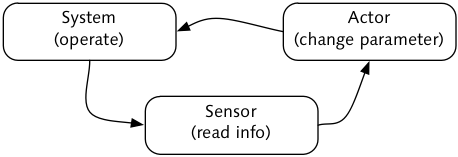
Let’s look at aspects of feedback loops. There is an actor to change the system operation as well as a sensor that reads some information. In order to actually be a feedback loop, the sensor is driving the actor.

Note that most systems allow data to be read at any time and (essentially) any frequency. However systems usually also do not immediately respond to changed input. Here’s an example: You could read a thermometer in your room as often as you like. And you can also turn the control of the heater up or down pretty often and yet the room temperature will not change immediately.

Usually there is no point in acting a whole lot faster than the system can react. If it takes ½ an hour for the room temperature to adapt to a newly set value, reading the thermometer and changing the control every minute doesn’t make much sense.

Some waste and some risk

Now, with the focus on short time scales and a high frequency of the measurements (no matter wether they are qualitative or quantitative), I can imagine two undesirable outcomes:

  1. In a situation where the system reacts slowly to changing parameters, measuring often is waste. This is because the system couldn’t possibly yield another outcome (yet).
  2. If we only measure with a rather coarse-grained way (e.g. only the values red, yellow, green), we might miss a slow trend. (I guess this is the reason we often suddenly must buy winter tires, even though we clearly noticed that the temperatures decreased over the past weeks and we’re wearing our long sleeved shirts and anoraks too.)

That said, if the system reacts fast on a change and we can get the feedback quickly, it’s very likely a good idea to actually get that feedback. A good example for this case: Having fast unit tests in programming. 🙂