Tag: Testing

Anthropomorphism And Dehumanisation In Testing — How Does It Affect Us?

Where it began

I find it interesting to keep track of where and when I run into new information relevant to software testing. This time it was an article in a German magazine for dog owners (issue 6 2012, to be precise). The topic was anthropomorphising dogs. And I think digging deeper into anthropomorphism can help us understand software development and testing better.

What is anthropomorphism?

This is the definition of anthropomorphism given on Wikipedia:

Anthropomorphism or personification is any attribution of human characteristics (or characteristics assumed to belong only to humans) to other animals, non-living things, phenomena, material states, objects or abstract concepts, such as organisations, governments, spirits or deities. (http://en.wikipedia.org/wiki/Anthropomorphism)

Why is it worth thinking about?

The German magazine article mentioned Adam Waytz as the author of a study and that way I found “Social Cognition Unbound: Insights Into Anthropomorphism and Dehumanization” by Waytz et al. (citation see end of this article).

The authors of the paper (details see below) say that “computers … can seem to have minds of their own” and mention that people “…curse at unresponsive computers…” (at least I have). If similar situations happened to you, maybe while testing software, then anthropomorphism affects your work.

I’m convinced that this topic requires more than a single post. This post is an introduction to the topic.

A brief summary of the paper

The authors discuss reasons for anthropomorphism as well as dehumanization and present three “primary factors——elicited agent knowledge, sociality motivation, and effectance motivation” which determine whether someone is likely to anthropomorphise or not.

Let’s look at the three factors:

Elicited Agent Knowledge
Anthropocentric knowledge is accessible and/or applicable.
Social Motivation
This is the need to be accepted, part of society and to connect to others.
Effectance Motivation
The motivation derived from understanding, explaining and (being able to) change or influence the environment.

Some ways this affects software testing

I will not go into much detail in this introductory post, but will instead list some of the behaviours that can be explained through this model:

  1. Effectance motivation and scripted testing
    I will not add to the discussion of the pros and cons of scripted testing, but instead introduce a possible explanation why testing and testers are not well respected in environments where scripted testing is used.
    When a rather strict execution of scripted test cases is demanded, the testers can’t influence their environment much. It’s about following scripts, manually operating the system under test and checking whether given conditions are met or not. In some cases changing scripts is not allowed, just following them. To others this looks like manually executing source code, something a computer is much more suited for. In other words: Testers work like computers, they’re perceived less human-like than they are.
    That way effectance motivation is inhibited, leading to dehumanising of the testers (at least to a certain degree).
  2. Test versus development teams—and what they perceive of each other
    I’ve worked in an environment where testers and developers were separate from each other. The most important communication was though the artefacts we were exchanging: Installed software on the test system, defect reports in a bug tracking system and may be the source code.
    We couldn’t see each other as the humans we are, it was (mostly) artefacts, the ‘other side’ didn’t even look remotely human. Thus neither side felt much respect for each other.
  3. System complexity
    The tester assumes the system is more complex than it is or has an intention that’s not there.
    Software systems, at least today, do not have a human intent. If a system under test is subject to anthropomorphism the tester assumes the system is more complex (or complicated) than it actually is and therefore puts more effort into testing. This can lead to new ways of testing or new test ideas and therefore improve the testing.

Leaving thoughts

This post introduced the idea that anthropomorphism affects software testing and described some of the effects. As mentioned above, I think there’s much more to discover for testing, so stay tuned for more posts about the topic!

Do you have examples of anthropomorphism in software testing? Please share them.

Cited paper

Waytz, Adam, N. Epley and J. T. Cacioppo. 2010. Social cognition unbound: Psychological insights into anthropomorphism and dehumanization. Current Directions in Psychological Science. 19: 58-62.

Agile Testing Days 2012 — YAS (Yet Another Summary)

Just like the years before I enjoyed the Agile Testing Days a lot. A fun theme throughout many of the talks were… unicorns and I think Gojko Adzic started it. This affected my brain so much, I said ‘Look, a unicorn!’ to my dog, when I took him for a walk for the first time after I came back from the conference. Actually, the animal crossing our path was a squirrel.

Here’s a short summary of my favourite parts. In order to stay in sync. with the printed & online conference program I’ll start counting the conference days at 0.

Day 0 – Tutorial “Software Testing Reloaded” with Matt Heusser & Pete Walen

Just as the full title “Software Testing Reloaded – So you wanna actually DO something? We’ve got just the workshop for you. Now with even less PowerPoint!” promised, there was only very little PowerPoint and a whole lot of testing & questioning.

I especially liked the way Pete & Matt presented the examples & exercises as well as the reasoning behind them.

Electronic Dice
Electronic Dice

There were a lot of games and actual testing. All was very hands on, well explained and debriefed at the end. To give just one example: We tested electronic dice, in order to give an estimation about how long testing would take and to come up with a recommendation whether these dice were ready to be used.

Questions like “Can we ship it now?”, “Is there a pattern/problem there?” and “What actually are the requirements?” were covered.

I also won a price, so my point of view might be biased. 😉

How to Reduce the Cost of Software Testing

Day 1

  • Get them in(volved) by Arie van Bennekum
    I found it super interesting to listen to one of the creators of the Agile Manifesto, especially since he pointed out that many of the principles and values have been around before the manifesto was written.
  • Myths About Agile Testing, De-Bunked by Janet Gregory & Lisa Crispin
    Lisa & Janet debunked myths as ‘Testing is dead’, ‘Testers must be able to code’ and ‘Agile = Faster’. Excellent story and fun presentation.
  • Consensus Talks – 7 10-minute-talks (including mine)
    The format of 10-minute talks, all back-to-back and no break included was the one I missed in the previous Agile Testing Days. This way a whole lot of ground is covered in a short time and it’s a great opportunity to explore new techniques in presenting without doing too much harm and/or presenting on conferences for the first time.
  • Self Coaching by Lasse Koskela
    Lasse explained how to coach yourself. After explaining how the human brain works he talked about how to step ‘out of the box’ (your personal point of view) in order to better understand what others actually say and to stay honest to yourself at the same time. Deep knowledge, very well explained indeed.
  • The MIATPP Award Night 2012
    Lisa Crispin won the MIATPP Award. Congratulations!

Day 2

  • Test Lab by James Lyndsay & Bart Knaack
    This year I went to the “Test Lab” and tested a small LEGO Mindstorm robot, that could move around on a coloured sheet of paper and react, depending which colour its camera would detect. The task: Find out what the specification of the robot is and find defects in its implementation.
    Very interesting: We had to come up with a hypothesis of how the robot was supposed to work as well as finding defects. I really enjoyed the way Bart & James gave feedback and asked the right questions.
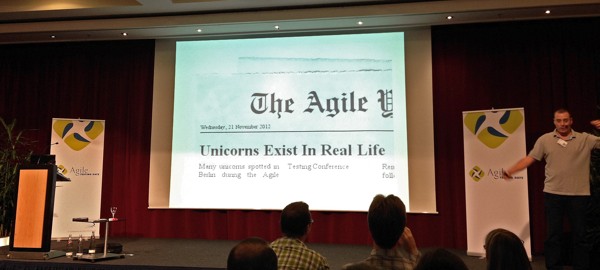
  • “Reinventing software quality” – Gojko Adzic
    Breaking News: Unicorns Exist

    Gojko made the point that in agile testing we might (still) not focus on the right thing: To build the right software. Instead we concentrate on finding bugs and building the software in the right way. He illustrated this with one of his books:  He found a defect and then spent a while searching & listing more problems and ended up with a good number of them, definitely enough to make you worry about the quality of the book. However, the publisher explained that essentially all reviews were very positive! So: When people keep paying for your product or service, worrying about defects may not be that important.

Day 3

  • “Fast Feedback Teams” – Ola Ellnestam
    explained the importance and value of fast feedback. And he’s right: In many projects feedback could be gathered a lot earlier and be used to improve what features are built (as well as how they’re built). Other talks at least touched this topic as well. And while I wholeheartedly agree about this, I’m also a bit worried that we (as software creators) might forget about (or even ignore) slow changing aspects (for more about this see my previous post ‘Slow Feedback Cycles‘).
  • “Exceptions, Assumptions and Ambiguity: Finding the truth behind the Story” by David Evans
    UK Explained

    David explained how natural language is ambiguous, unclear and sometimes hard to understand. His examples included part of Jabberwocky (in several natural languages), music lyrics and last but not least programming. Also, I like his short introduction of the Cotswolds.

  • “It’s the Economy, Stupid! Learn the fundamentals about the one and only argument which will drag your management into agile practices” by Lucius Bobikiewicz
    Lucius talked about economic reasons of letting teams focus on 1 (one!) project/product, as opposed to working on multiple projects/products at the same time. It didn’t surprise me much, that letting teams finish one thing and then progress with the next is economically favourable. But  I was very surprised how much of a difference it made in the example he presented. These are the main advantages of the 1-project-only team Lucius presented:

    1. The time between the 1st project start and the first paid project (usually at the end of the project) is much smaller, meaning that significantly less money is needed to fund the upfront costs.
    2. Given the limited period of time in which a software can be sold, the product can likely be launched at the optimal time, whereas multi-product-teams may enter the market later and therefore always lag in selling.
    3. Since the overhead of context switching is minimised, the team can work on more projects/products per time unit. This advantage depends on the amount of time needed per context switch and the time the projects take .

    The economic point of view Lucius presented was a surprising and welcome detour form the other sessions which were much more focused about technology and/or ‘doing the right thing and doing it right’.

Every morning of the conference days 1-3 Lisa Crispin organised a Lean Coffee in one of the hotel bars. In small groups we discussed topics people were interested in. In order to cover some topics we limited the time for each topic to an initial 8 minutes and then added another 4 minutes depending on a quick vote. I find this is a very fun way to find and discuss topics. Thank you Lisa for organising them!

As a leaving thought: The chair persons were given (foldable) chairs as a present — ‘chairs for the chairs’. Super funny, if a tad bit unpractical to get home via train or airplane.

A big “Thank you!” to José, Uwe and Madelaine as well as the other organisers that made the Agile Testing Days such a great and enjoyable conference.